This morning we experienced our first full frost of the season as the temperatures at the course dipped to 25 degrees. It was quite a shock to the system since we were at 79 degrees at the end of last week. As this will not be our last frost, and in turn frost delay, this year I wanted to try and pass along some information about why we need to keep foot traffic, cart traffic, and maintenance equipment off of frosted grass in order to keep it alive and healthy.
Again the United States Golf Association can explain better than I can what happens to grass when it is under the grips of cold weather and frost.
We all hate to have our round delayed but we have worked too hard to get our golf course back in shape this year to allow anything to risk damaging it now. So please be patient as we allow the frost to burn off and realize that we are doing it for the betterment of the golf course, not to keep you from your round.
Good Lord willing you will not see any heavy equipment tearing up the golf course this winter like last year with The Renovation of #3 Green and Installation of Drainage in #10 Fairway. We will be continuing to make improvement to the golf course however with smaller projects. Projects for this winter will include limbing up of trees to provide clearer shots for you the golfer and more sunlight for the turf. We will also be installing more cross tie curbing along the cart paths in needed areas and will be renovating the main sign at the front entrance. Lots of work but all intended to make your course better.
As I said before we are going to make every decision this winter with the health and survival of the turfgrass in mind. So we may not be mowing the greens first thing in the morning or changing cups right before play goes out or other practices that are routinely done before play during the summer. These practices will be done later in the day when we are positive that the greens surface and the surrounds are free of frost and are not frozen.
We will be foregoing our normal painting of the greens this year in an effort to eliminate any foreign substances covering the leaf blades and blocking any issues that we need to be seeing during the dormant season that might be harming the greens. Hopefully there will be enough distinction between the putting surface and the greens surrounds and if needed we will apply a dose of our normal green dye that we use when applying our routine foliar fertilizer and plant protectants.
I can also tell you to expect a greater probability of the greens being covered this winter compared to past years. In the past I have pushed the envelope on whether or not to cover the greens during questionably and potentially damaging weather to try and keep the golf course open for play. However I realize that I may have been putting the health of the turfgrass at a greater risk than what the reward was worth. Like all other decisions, when and if we cover will be done with the greens health and survivability in mind.
As you can tell from the tone of this post there is a different mindset at Harrison Bay going forward. We have recovered from a trying and hard summer and our course is in the best condition that it has been in many, many years. We will do what ever it takes to keep it that way and we hope you understand and agree with our decisions.
I really wish it only took this long to cover a green but in reality when you have a great crew, who know what they are doing, it can be that easy. Covering greens is not an easy process but to help ensure the survival of ultradwarf greens in the transition zone it is a necessary evil. No one likes to close a golf course to play but then again no one likes greens that are damaged in the summer from winter laziness or poor decisions.
Here is a link from a previous blogpost including a webcast from the United States Golf Association which better explains covering greens.
So much like you or I need a coat on when it gets cold outside, our greens do also, especially this year with the warm weather and the extended growth of the grass. Covering the greens will increase the temperatures under the covers from 5-8 degrees higher than the temperature outside of the cover. This may not sound like much but that slight increase in temperature can be the life and death of ultradwarf greens. It takes a little work to protect them but it is worth every second in the long run. And it is still better than syringing bentgrass greens all summer long.
With the recent cold weather and our greens currently being covered I thought it would be nice to share this webcast by Mr. Patrick O'brien, USGA Agronomist for the Southeast Region. This short 10 minute webcast answers many of the questions many golfers have about using turf covers for bermudagrass putting greens.
On Monday the Agronomy Staff spent several hours pulling the covers on the greens. Some of you may wonder why we cover the greens at certain times so I wanted to try and explain why. Our ultradwarf greens are most susceptible to injury during the winter months because they do not go completely dormant and yet are not actively growing either. They still have live green tissue in the leaf and crown area which can be killed or damaged by winter desiccation or sudden cold temperatures. Much like you need a coat on to go outside right now, our greens need a little extra protection to survive the cold nights.
Here is an example of how the covers help to protect and insulate the greens. The air temperature at 7:35 this morning was 25 degrees with a wind chill of 16 degrees. The measurement on the top is of an area which was covered all night. Our soil thermometer gave us a reading of 38.8 degrees while the bottom picture shows an area that was uncovered which had a soil temperature of 30.1 degrees. Simple explanation for using covers is this, turfgrass plants have water inside of them inside of the plant cells. If this water is allowed to freeze it will, and often does, act like a balloon when frozen, it will burst. Turfgrass cells which are damaged or burst/killed in the winter months will not revive themselves and the damaged areas on the greens will not green up in the spring.
Having the golf course closed for a few days while the covers are deployed is a minor inconvenience compared to the alternative which could like this green pictured here. We will only pull the covers when I feel it is necessary to protect the golf course, not just to keep you off the course. Trust me, pulling covers is not a fun task in the first place.
One of the biggest concerns with growing ultradwarf bermudagrass greens in the transition zone is winter damage. This damage occurs when the air temperature drops into the lower 20s or below. One way to protect against winter damage is through the use of greens covers. Our "rule of thumb" to protect our greens is to cover them when the temperatures are forecasted to be below 25 and not above 35 degrees F for 48 hours.
We use Covermaster covers from Evergreen which are light weight woven plastic which will increase the temperature under the covers by 10-12 degrees keeping the greens protected from damage. With the forecasted temperatures for tomorrow being a low of 20 and a high of 38 we will take no chances in protecting our greens.
The covers are pulled from one end of the green to the other. After several years of deploying the covers during the winter months we have the process down pretty good.
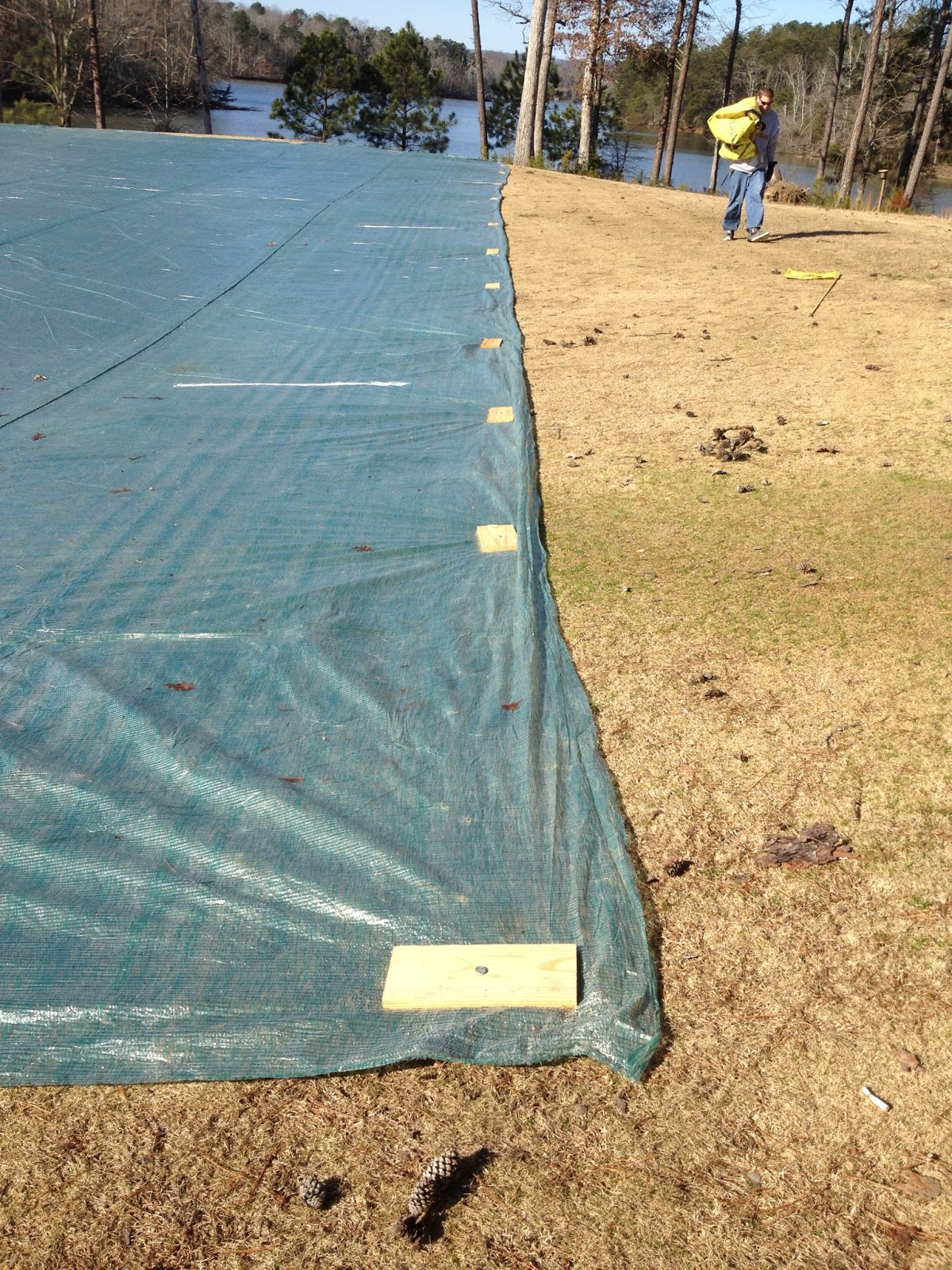
The covers are straightened and pulled tight.
We have used several methods of securing the covers to the ground over the past years from sod staples to bags of fertilizer the time we waited too late and the ground was already frozen but have found the best method for security and speed of deployment is using 1"x6" boards cut about 12 inches long with a 1/2" hole drilled in the middle. We use a 10 inch 1/2" spike to secure the cover down.
Ten minutes and we are done covering this green and off to the next. Deploying all 19 covers will take our crew about three and a half hours.
The greens will stay covered until Wednesday when the temperatures are supposed to be much warmer.