Showing posts with label greens covers. Show all posts

Monday, January 28, 2019

2018 Recap, Bridge Refurbishments, and Covering Greens

Yes, it has been quite a while since our last blogpost update and for that I apologize.  2018 was a great year at Harrison Bay with some of the best course conditions our Agronomy Staff has produced in quite some time.  Irregardless of the 83 inches of rainfall we received in 2018 (normal amount is 57") our small crew of dedicated team members continued to provide quality, championship conditions while continuing to make course improvements and advances.

One of the improvements we have been working on this winter is to repair and cleanup the bridges which span our wetland areas on holes 13 and 14.  We have removed and replaced any rotting or weak boards from the decking, have begun the process of pressure washing the bridge, and have installed a woven rubber liner in the center of the bridge to make it safer for our walking guests to travel across the bridge.

The walkway material is from PEM Surface and is an excellent product providing a porous, nonslip surface which is easily secured to the decking with silicone glue and decking screws.  We have already had several of our regular walking golfers comment and thank us for this project.  We will finish the project up this month and seal the bridge to help keep this clean, fresh look.

With the cold temperatures heading into the south this week we pulled the covers over the greens today to help protect them.  We do not cover as much as others, and that is perfectly fine.  No two golf courses are the same and no two golf course superintendents do the exact same processes.  We have 15 years of experience with what our greens can handle and our microclimate on the lake gives us a little advantage of staying warmer than other areas in town.


I was asked today "How do the covers actually help protect the greens?".  The illustration to the right does a very good job of describing how the greens covers work but in a nutshell the covers are designed to allow radiant heat from the sun to pass through the cover but not back out easily.  The sunlight warms the leaf tissue and the soil and "traps" the heat against the surface compared to uncovered greens in which the collected heat of the day is easily lost and the surface and soil temperature of the green is allowed to fall to levels detrimental to the health of the plant, and in turn the longterm health of the green.


I hope this helps explain why there are times, like today, when we have to pull the covers during the day when the sun is out and it is all nice and warm and you would love to be out playing golf.  In our experience if we wait too late and pull the covers at the end of the day we are losing a complete day of heat generation and capture and undermining the benefit of the covers.

It is our plan to remove the covers at the end of the week and have the course ready for play for the weekend.  We will update as we get closer to the weekend.


Friday, January 9, 2015

USGA Webcast on Covering Bermudagrass Putting Greens

With the recent cold weather and our greens currently being covered I thought it would be nice to share this webcast by Mr. Patrick O'brien, USGA Agronomist for the Southeast Region.  This short 10 minute webcast answers many of the questions many golfers have about using turf covers for bermudagrass putting greens.

Please use this link to view


Tuesday, July 9, 2013

Chipping Green Update

Well after a week of almost eight inches of rain we finally got out on the course to do some maintenance today.  It will take a few days of mowing to get the turfgrass back down to the heights that we are all used to, so please be patient with us.

 One thing we did today was remove the cover from the newly sprigged chipping/nursery green.  It has been nine days since Champion Turf Farms planted the green and with the very minimum sunlight we have had I was very surprised to see the sprigs greening up and trying to root down.
 The area down toward #10 tee which was added on is doing better than the original green area because of the lack of drainage in this new area and because of the high moisture holding capacity of this sand.  It might take the upper area a little bit longer to fill in but all in all it looks very good.
I am very pleased with the process of using the greens cover to protect the sprigs following sprigging.  We have had some very heavy rains over the past week and I can say almost certainly that if the sprigs had only been covered with topdressing sand we would have a pile of sprigs at the bottom of the hill.  I think the cover protected the sprigs from washing and also helped to heat up the soil or retain any heat generated during the day.  I also like the fact that the new sprig doesn't have to use any of its stored energy to emerge from a layer of sand, it can just start trying to root down.

Saturday, February 16, 2013

Protecting the new sod

 We recently repaired some of the areas on the greens which were damaged last season with some new sod from Champion Turf Farms.   The temperatures forecasted for our area for the weekend did not warrant the covering of the entire greens but we wanted to add a layer of protection for the new sod since the root system in not established.


Since the areas are small and irregular shape we chose to use a black permeable landscape fabric that we purchased from our local hardware store.  The fabric was installed on Friday afternoon to allow time for heat to be trapped under the cover before the cold overnight temperatures arrived Friday night.  The sod was heavily irrigated prior to installing the liner for added protection.

Mitch and Bill used sod staples to secure the fabric over the sodded areas. We will leave these covers on the sodded areas over the weekend and remove them next week.  Hopefully this "greenhouse effect" will improve the rooting of the sod and help it to survive.  As the season progresses we will be topdressing these areas regularly to smooth them out even more.


Monday, January 21, 2013

Protecting the Greens with Covers


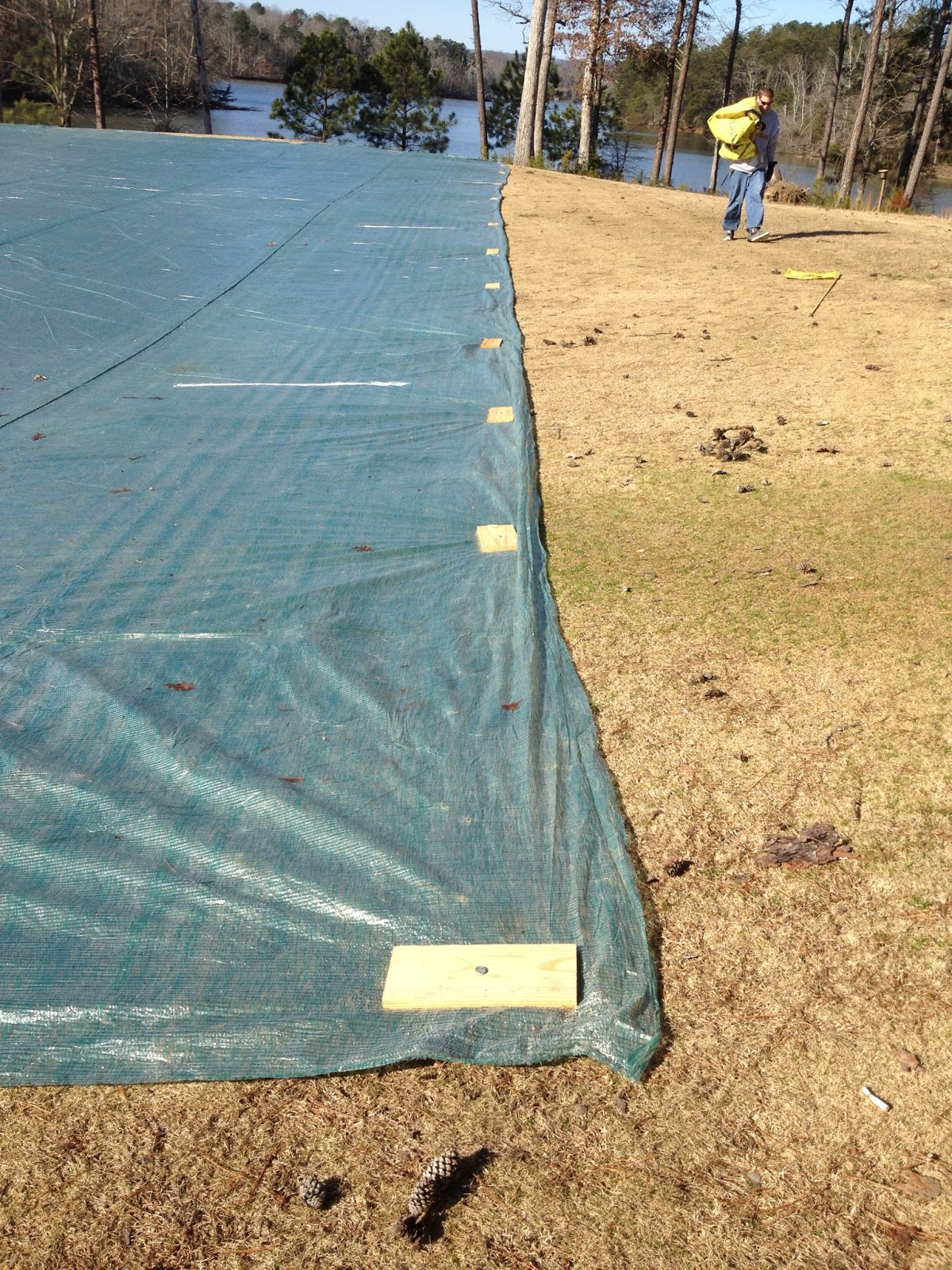
One of the biggest concerns with growing ultradwarf bermudagrass greens in the transition zone is winter damage.  This damage occurs when the air temperature drops into the lower 20s or below.  One way to protect against winter damage is through the use of greens covers.  Our "rule of thumb" to protect our greens is to cover them when the temperatures are forecasted to be below 25 and not above 35 degrees F for 48 hours.


We use Covermaster covers from Evergreen which are light weight woven plastic which will increase the temperature under the covers by 10-12 degrees keeping the greens protected from damage.  With the forecasted temperatures for tomorrow being a low of 20 and a high of 38 we will take no chances in protecting our greens.


 The covers are pulled from one end of the green to the other.  After several years of deploying the covers during the winter months we have the process down pretty good.

 The covers are straightened and pulled tight.

 We have used several methods of securing the covers to the ground over the past years from sod staples to bags of fertilizer the time we waited too late and the ground was already frozen but have found the best method for security and speed of deployment is using 1"x6" boards cut about 12 inches long with a 1/2" hole drilled in the middle.  We use a 10 inch 1/2" spike to secure the cover down.

Ten minutes and we are done covering this green and off to the next.  Deploying all 19 covers will take our crew about three and a half hours. 

The greens will stay covered until Wednesday when the temperatures are supposed to be much warmer.

Tuesday, December 14, 2010

Greens Covering

We recently deployed our covers to protect our greens from the harsh temperatures and high winds that we are experiencing.  The covers are used to help reduce the desiccation of the turfgrass plant caused by the cold wind blowing across the plant surface and removing moisture from within the plant thus causing it to be damaged.  The covers also serve as insulating blankets for the greens increasing the temperature under the covers by up to 10-12 degrees F.  This increase in temperature protects the crowns of the plant and the root system from possible cold weather damage.  We hope to have the covers pulled off by Friday and the course opened back up for play.