Monday, January 21, 2013

Protecting the Greens with Covers


One of the biggest concerns with growing ultradwarf bermudagrass greens in the transition zone is winter damage.  This damage occurs when the air temperature drops into the lower 20s or below.  One way to protect against winter damage is through the use of greens covers.  Our "rule of thumb" to protect our greens is to cover them when the temperatures are forecasted to be below 25 and not above 35 degrees F for 48 hours.


We use Covermaster covers from Evergreen which are light weight woven plastic which will increase the temperature under the covers by 10-12 degrees keeping the greens protected from damage.  With the forecasted temperatures for tomorrow being a low of 20 and a high of 38 we will take no chances in protecting our greens.


 The covers are pulled from one end of the green to the other.  After several years of deploying the covers during the winter months we have the process down pretty good.

 The covers are straightened and pulled tight.

 We have used several methods of securing the covers to the ground over the past years from sod staples to bags of fertilizer the time we waited too late and the ground was already frozen but have found the best method for security and speed of deployment is using 1"x6" boards cut about 12 inches long with a 1/2" hole drilled in the middle.  We use a 10 inch 1/2" spike to secure the cover down.
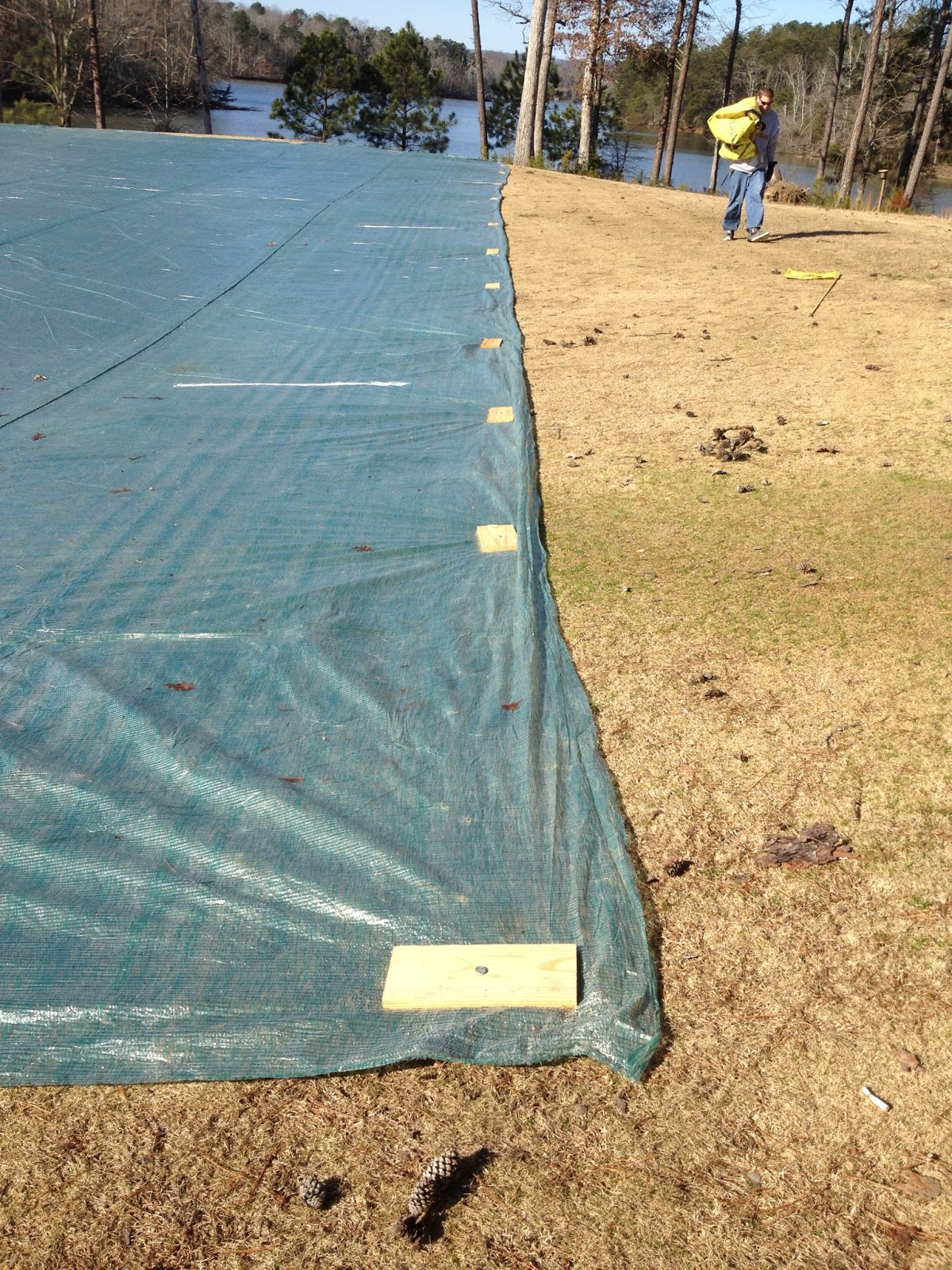
Ten minutes and we are done covering this green and off to the next.  Deploying all 19 covers will take our crew about three and a half hours. 

The greens will stay covered until Wednesday when the temperatures are supposed to be much warmer.

Monday, December 17, 2012

Time to Paint the Greens


 It's that time of year again to paint the greens for the winter months when our Champion ultradwarf bermudagrass greens go dormant and loose their green color. The paint serves several purposes including providing our golfers a target, absorbing heat to increase the surface temperature of the green compared to an unpainted green and help to give us a jump start to the spring by helping the greens come out of dormancy earlier.
 Above is our 18th hole before it is painted.  To the right Willie Hamby is applying the first or base coat of paint to the green.
 Finishing up the first coat.  We have used many different products over the nine years we have been painting our greens but have had our greatest success with our current mixture of Green Lawnger and AquaStripe Black.
 Applying the second coat of paint to 18 green.  We apply the product in two directions and do two clean up laps which gives us a defined appearance and keeps the paint from going outside of the greens surface.
 #18 green completed.
 
#18 green from the fairway following paint application.

Wednesday, November 14, 2012

"Water Zits", leaves, and eagles

You never know what you might find on a morning ride around the golf course.  This was the scene in the middle of #2 fairway the other morning where a huge "water zit" had popped up thanks to a leaking irrigation pipe.  This was by far the largest one I had seen in a long time.

Hats off to the maintenance staff who have been working steadily and tirelessly to herd the leaves off of the golf course this fall.  It seems like a never ending job once they start falling but the crew has done a great job, to which many people have commented with appreciation.


A new season for the Harrison Bay Eagle Cam is getting underway with the installation today of new cameras in the new nest tree.  Catch up on the activities on the Harrison Bay Eagle Cam blog.

Monday, October 29, 2012

TurfNet Bandon Dunes 2012 Trip Day Seven


Our last day on the TurfNet Bandon Dunes 2012 Trip took us to Eugene Country Club.  This is officially my favorite golf course that I have ever stepped foot on.  I hope the beauty of this golf course can be seen in the following photos, but I seriously doubt it.


Special thanks to our host, Mr. Chris Gaughan, CGCS for allowing us to play this magnificent golf course.


The trees at Eugene Country Club are amazing and majestic.  Many of them are over 100 years old and just tower silently over the golf course.  The different textures and hues of the trees and the landscape are one of the features that make this golf course so absolutely stunning.


Eugene Country Club is also the home golf course for the Oregon Ducks university golf team.  Some of their fans were out to view the golf course today.  Head golf coach for the Oregon Ducks, Casey Martin, of PGA fame, was at the course today as well.  His home course from his youth.
 This has been a trip of a lifetime for me and I am very appreciative to all the sponsors and especially the great folks at TurfNet, Peter McCormick and Jon Kiger for granting me the privilege of this experience.  I met a lot of great guys from all over the nation this week, had some great times with Robin, and saw some beautiful and amazing golf courses.
 
TurfNet Bandon Dunes 2012 trip is in the book and it is back to Harrison Bay.


Sunday, October 28, 2012

TurfNet Bandon Dunes Trip 2012 Day Six

Our final day at Bandon Dunes Golf Resort has us on what we are told is the most popular golf course of the four, Pacific Dunes.  A more challenging golf course with more demanding terrain and deeper bunkers. 
Today's round was played in the rain and wind for the most part of the morning but we can't complain because of all the great weather and times we have had so far.


Several holes along the ocean were really fun to play today because at times the rain was coming at us sideways.
 
Back in Eugene now to play Eugene Country Club in the morning as the final leg of the 2012 TurfNet golf trip. 


Saturday, October 27, 2012

TurfNet Bandon Dunes Trip 2012 Day Five

Day 3 at Bandon Dunes Golf Resort had us on the Old MacDonald golf course.  A very wide open, free flowing old style golf course and of course it was in wonderful condition.

We were blessed today to play with another great couple of guys, Mr. Mike Cook of The Care of Trees, Inc. and Mr. Scott Schakraft of Huntsville Country Club.  These two good friends joked around and needled each other all day and like Robin and I just simply enjoyed the round.

Old MacDonald golf course is a very forgiving golf course with very forgiving and wide fairways.  It was great to just hit the ball and go find it, and hit it again.  Only one ball lost today.


Two of the main features of Old MacDonald are the deep and free flowing  bunkers and the enormous sized greens.  At Bandon Dunes Golf Resort they mow the greens off into the approach so it is difficult at times to determine where the greens surface stops and the fairway begins.

 
Several bunkers were laced with used railroad ties which gave a great diversity to the landscape and to the playability of the golf course.  You would be amazed how high in the air a golf ball goes when it hits a slanted railroad tie at just the right angle.
 
 
Bunkers are actually considered "hazards" at Bandon Dunes.
 
 
 I tried to show you the bunkers at Old MacDonald.  Here is an example of the enormous greens on the course.  It is the green at #8 and is over 22,000 square feet in size.  We were told it took around an hour and fifteen minutes to walk mow this one green and I can believe it.
 
Great day at Old MacDonald and off to Pacific Dunes in the morning.