Friday, March 8, 2013

Greens mowers and ice


We finally got out to use our new Jacobsen Eclipse 322 Electric greensmowers this morning and I have to say we are thoroughly impressed with their operation and the amazing quality of cut the 15 blade reels provide.  I am really excited about the quality of putting surface we will be able to provide our golfers thanks to these mowers.


Bill, Jonathan, and Eric have been working hard this winter to finish up the four year bunker renovation project of the greenside bunkers at Harrison Bay.  Our bunkers used to be our biggest complaint and one of our biggest budget expenses but that has all changed and we can provide now our golfers and guests with some very good bunkers to play out of.  The remaining three greenside bunkers will be completed in the next week or two. We are also going to work on improving the fairway bunkers which we have had some comments about by adding the sand we removed from the greenside bunkers to the fairway bunkers which will give them much needed sand and a firmer surface which is what you want in a fairway bunker sand.


We found an irrigation head stuck on on #4 green this morning and were surprised to see the layer of ice which had accumulated on the bunker face overnight.  Pretty funny to see the grass blades incased in an ice cocoon. 


Saturday, March 2, 2013

Electric Greensmowers and Greens Rollers Arrive


 What better way to wrap up a great week of operations at the golf course than to take delivery of our new fully electric Jacobsen Eclipse 322 greensmowers and our new fully electric Tru-Turf greens rollers.


 Mitch is trying out the new Eclipse mower.  The operation is so quiet all you can hear is the sound of the reels turning.  It has been a long time since we have been able to cut any green grass and the arrival of these greensmowers just adds to that desire.  Really looking forward to a great year and some of the best manicured greens we have ever had.

 
We also took delivery of the new 48 volt Tru Turf Electric greens roller which will help us to provide faster, firmer greens.  The tri-roller smoothing heads and the rubber coated drive roller will help us to roll the greens in almost any direction without the fear of leaving creases or lines in the putting surface.
 
 
Here is another quick video to demonstrate the quietness of the electric equipment. 
 
Only a couple more pieces of equipment to be delivered and some finish up work in the golf course maintenance building by Ooltewah Electric and the Electric Equipment Initiative will be in full swing.


Tuesday, February 26, 2013

Electric Equipment Initiative at The Bear Trace at Harrison Bay

How great for the environment would it be to be able to maintain the golf course without burning a single drop of fuel?  Well, that may seem like a dream but it is one that we are going to chase at Harrison Bay.  In an effort to reduce our impact on the environment through the emission of carbon emitted by our current gasoline engines we are converting the majority of our golf course maintenance equipment to a fully electric battery powered fleet.

This Electric Equipment Initiative, as we like to call it, will involve the replacement of gasoline combustion engines on our greens, tees, approaches, bunker rakes, greens rollers, and our staff utility vehicles with fully, 100% electric equipment.  It will be a total of 19 pieces of equipment which will allow us to maintain the golf course without polluting the air with carbon emissions and will allow us to not disturb our golfers and guests with the operation of loud equipment.

Working with the great people in the Office of Sustainable Practices in the Tennessee Department of Environment and Conservation we were able to obtain funding from Tennessee State Parks and the Tennessee Valley Authority for this project through the Clean Tennessee Energy grant.  By converting our gasoline burning equipment to all electric equipment we estimate we will reduce our gasoline consumption by over 12,000 gallons, eliminate the emission of over 215,000 pounds of point source carbon, and reduce our maintenance expenses by over $30,000.00.

It has taken a while to get the project off the ground but we are getting very close to seeing it be a reality.  The equipment we chose for the project is the Jacobsen Eclipse 322  triplex mower for greens, tees, and approaches, the Smithco Super Star 48 volt bunker rake, the Tru Turf R52  greens roller, the Toro Workman MDE, and the Club Car Carry All Turf II.  These units will allow us on many days to maintain our golf course without burning a single drop of fuel or emitting a single pound of point source carbon emission.  The goal of the whole project.

We have taken delivery of a couple pieces of equipment last week which have already been placed into service and are operating beyond our expectations.

Mitch is trying out the new Smithco Super Star bunker rake.


Left is a video of Willie operating one of the new fully electric bunker rakes.  Be sure to turn your volume up so you can hear the full experience.


We also chose to replace the staff vehicles with fully electric Toro Workman MDE vehicles.  These vehicles will allow the golf course staff to perform their duties around the golf course quietly so as not to disturb the golfers or the wildlife.  Win Win for everyone.

The Toro Workman MDEs are powered by a powerful 48 volt system which we have already found to have all the power we need to haul fertilizer, sand, and a trailer around the golf course.


We are anxiously awaiting the arrival of the remaining equipment and the onset of spring so we can put it all into operation.  We can already tell that one of the biggest things we are going to have to get used to is not hearing the sound of the gasoline engines as we perform our work but that is something we will gladly get used to.

Monday, February 18, 2013

New Irrigation Installed on #16 Green


 With the success of the half head irrigation installation on #5 green last year turning that green from possibly our worst green to one of our best we have been looking for the opportunity to do the same to several other greens.  With the much needed break in the rainy weather we have been experiencing this winter we took Thursday and Friday to install new full circle and part circle irrigation heads around #16 green.


We replaced all the old full circle heads with new ones and positioned new part circle heads which will only water the greens surface.  This will allow us to apply more needed water to the putting surface without "flooding" the surrounds and making them saturated and undesirable.

 
New pipe and fitting were installed by Mitch and Willie.


All the swing joints, tees, and dead ends which were created during the installation were thrust blocked to hopefully eliminate any movement of the pipe which will cause leaks or blowouts.

Willie and Jonathen performing possibly the worst part of the job, the cleanup.  You never can get the dirt to go back in the hole the way it came out.

Once all the dirt was picked up the surrounds were blown off and we were done.


Installation Complete.  Like we were never even there. 

Thanks to the crew for a job very well done.

Saturday, February 16, 2013

Protecting the new sod

 We recently repaired some of the areas on the greens which were damaged last season with some new sod from Champion Turf Farms.   The temperatures forecasted for our area for the weekend did not warrant the covering of the entire greens but we wanted to add a layer of protection for the new sod since the root system in not established.


Since the areas are small and irregular shape we chose to use a black permeable landscape fabric that we purchased from our local hardware store.  The fabric was installed on Friday afternoon to allow time for heat to be trapped under the cover before the cold overnight temperatures arrived Friday night.  The sod was heavily irrigated prior to installing the liner for added protection.

Mitch and Bill used sod staples to secure the fabric over the sodded areas. We will leave these covers on the sodded areas over the weekend and remove them next week.  Hopefully this "greenhouse effect" will improve the rooting of the sod and help it to survive.  As the season progresses we will be topdressing these areas regularly to smooth them out even more.


Friday, February 1, 2013

Mallard Duck Nesting Tubes Revised


Our mallard duck nesting tube project has been one of our most viewed projects on the blog over the past year.  As this was a project Bill and Mitch designed in house there were some aspects that we did not account for and so in order to prepare the nesting tubes for the upcoming nesting season we made some minor changes and improvements.


 The biggest issue that we noticed with the construction of the nesting tubes was that the large 2" x 3" openings in the coated garden fencing allowed the pine straw to become dislodged during heavy rain storms.  In order to compensate for this problem we decided to bring the nesting tubes in, disassemble them, and add a layer of chicken coop wire around the outside of the inner tube.


 New pine straw was spread over the remaining nesting tube fencing.


The nesting tube was rolled back up and secured with new hog rings.

Here's Mitch with the "new and improved" mallard duck nesting tube.  They also added a small platform on the front of the nesting tube for the ducks to land on or use as a diving board when it comes time to go swimming.  Even mallard ducks need a little fun, once in a while.


Mitch and Willie decided that today, even though it was only in the upper 20s, would be a great day to reinstall the nesting tubes in the irrigation lake.

The forethought of using the U channel road signs came in very handy as it made reinstalling the nesting tubes rather easy, although rather cold.  The tubes were refilled with broomsedge and straw from the surrounding area and the nesting tubes were positioned so the platform would be facing out to the water.

The nesting tubes have all been renovated and reinstalled in the irrigation lake.  We are hopeful for a successful nesting season with many little mallard ducklings to follow.


Thanks to Mitch, Bill, and Willie for all their hard work and dedication.


Monday, January 21, 2013

Protecting the Greens with Covers


One of the biggest concerns with growing ultradwarf bermudagrass greens in the transition zone is winter damage.  This damage occurs when the air temperature drops into the lower 20s or below.  One way to protect against winter damage is through the use of greens covers.  Our "rule of thumb" to protect our greens is to cover them when the temperatures are forecasted to be below 25 and not above 35 degrees F for 48 hours.


We use Covermaster covers from Evergreen which are light weight woven plastic which will increase the temperature under the covers by 10-12 degrees keeping the greens protected from damage.  With the forecasted temperatures for tomorrow being a low of 20 and a high of 38 we will take no chances in protecting our greens.


 The covers are pulled from one end of the green to the other.  After several years of deploying the covers during the winter months we have the process down pretty good.

 The covers are straightened and pulled tight.

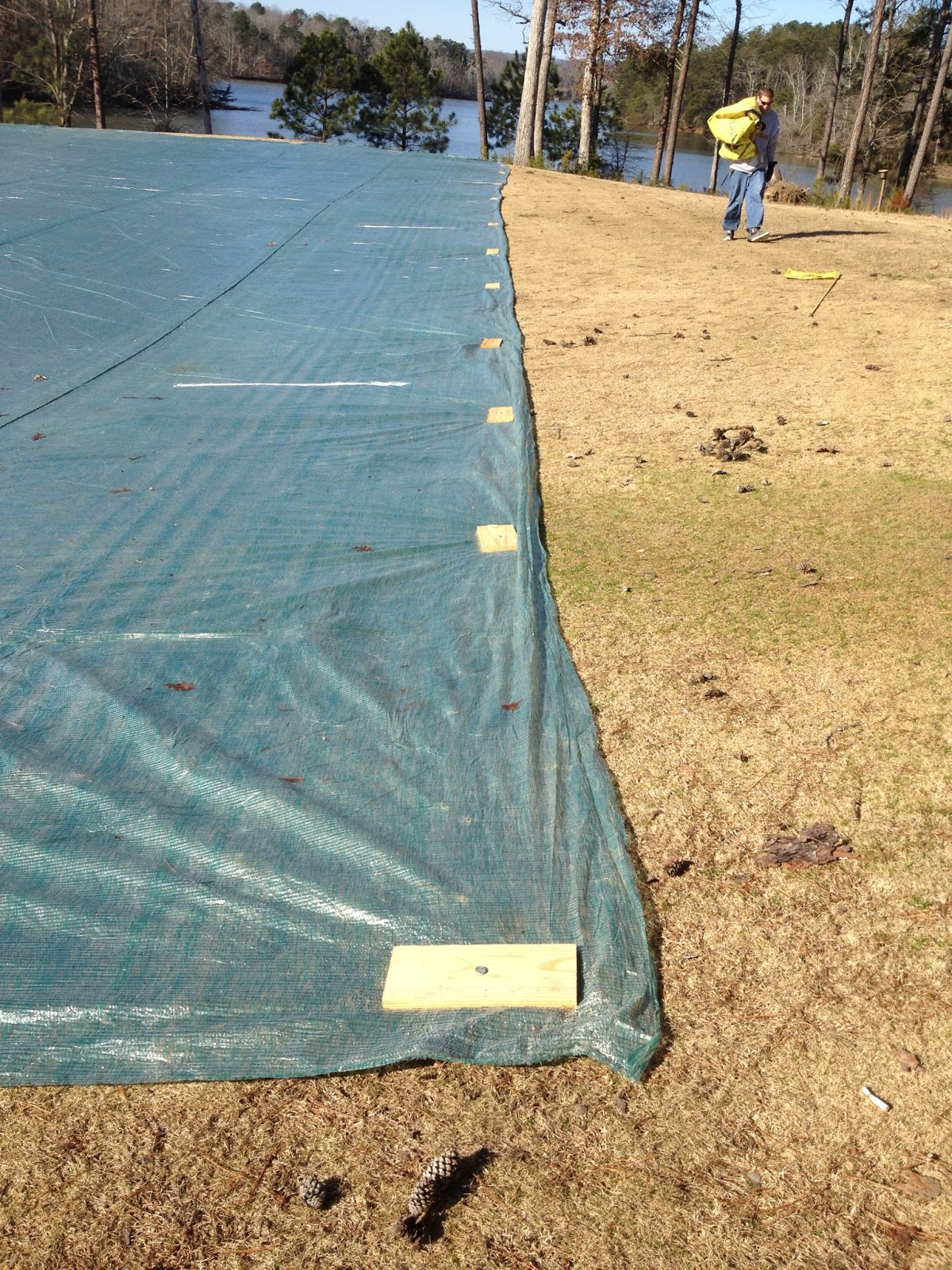
 We have used several methods of securing the covers to the ground over the past years from sod staples to bags of fertilizer the time we waited too late and the ground was already frozen but have found the best method for security and speed of deployment is using 1"x6" boards cut about 12 inches long with a 1/2" hole drilled in the middle.  We use a 10 inch 1/2" spike to secure the cover down.

Ten minutes and we are done covering this green and off to the next.  Deploying all 19 covers will take our crew about three and a half hours. 

The greens will stay covered until Wednesday when the temperatures are supposed to be much warmer.